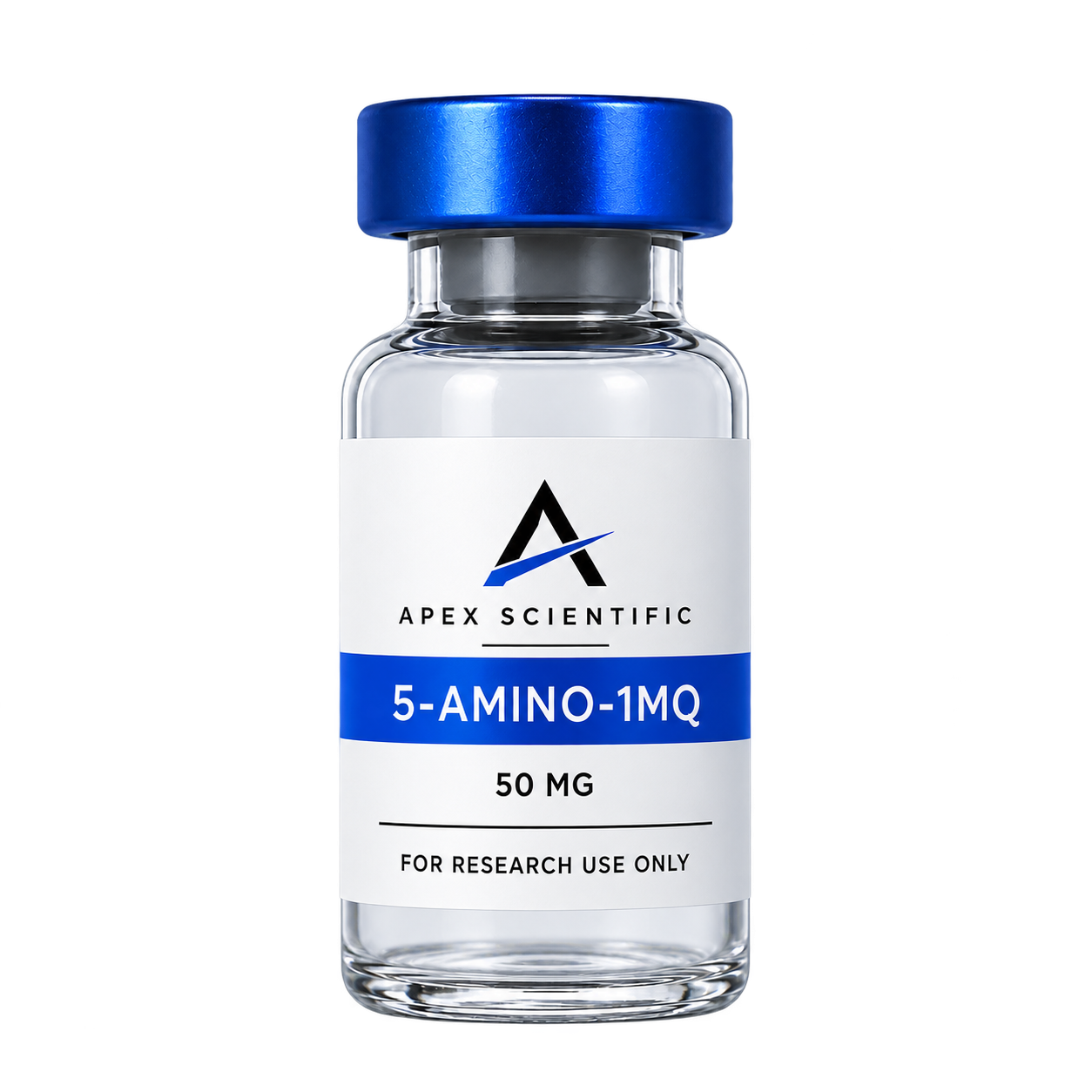
5-AMINO-1MQ
Fat metabolism & glucose handlingResearchers study an enzyme linked to metabolism, fat cells, and NAD-related pathways. Published outcome evidence is preclinical, not human.

The Apex compound guide
Begin with the potential benefits people discuss. Then follow the compound into the body, understand how it functions, and see what human evidence actually shows.
Explore the compound guide
Browse every profile immediately, or use the menu to focus on the potential benefit that interests you.

Researchers study an enzyme linked to metabolism, fat cells, and NAD-related pathways. Published outcome evidence is preclinical, not human.

It was developed to explore fat metabolism without the full effects of growth hormone. Larger human research did not show a significant weight-loss benefit.

Human trials have reported substantial body-weight reduction, improved glucose control in type 2 diabetes, and reduced liver fat in a smaller MASLD substudy. APX-3 remains investigational, and those findings do not apply to an independently sold research material.

It is widely discussed for healing, inflammation, and digestive-tract recovery. Those themes come mainly from animal research, not proven human outcomes.

The combination attracts interest for healing, tissue response, and exercise recovery. Evidence for those outcomes is largely from laboratory and animal research.

The blend is discussed for growth-hormone and IGF-1 signaling, with interest in recovery, muscle, and fat. Those outcome claims are not established in people.

Its name has made it popular in sleep discussions, but the human research is old, very small, and too inconsistent to show a reliable benefit.

Research explores telomeres, cell aging, and neuroendocrine signaling. Cell-culture findings do not demonstrate longer life or slower aging in people.

Interest includes collagen-related pathways, skin appearance, and wound response. Human evidence is limited and depends heavily on the formulation used.

Glutathione is central to the body's antioxidant system. Studies of changing glutathione levels show mixed, formulation-specific results.

Researchers use it to study cell growth and IGF-1 signaling. Muscle and recovery benefits have not been established in controlled human studies.

Interest centers on metabolism, exercise response, and how mitochondria communicate with the rest of the cell. Human benefit has not been established.

NAD+ is essential to energy and DNA-repair pathways. Direct human research is still limited and does not establish broad anti-aging or performance benefits.

Researchers study melanocortin pathways involved in sexual desire. An approved medicine exists for a specific population, but that does not apply to a research vial.

Interest centers on stress response, anxiety measures, and cognition. The available human reports are small and have limited independent replication.

It is discussed for cognition and neuroprotection, but much of the evidence is preclinical or from region-specific studies that are not broadly replicated.

Researchers have explored mitochondrial function, exercise capacity, and fatigue. Human trials have produced mixed results in specific medical conditions.

Researchers study how it influences growth-hormone signaling, IGF-1, and visceral fat. An approved medicine exists for one specific condition and formulation.

Interest focuses on T cells, innate immunity, and immune signaling. Human results vary by disease and study, and they do not support a general immune benefit.
Inside every compound guide
Each profile follows the same four-step path so you can move from the simple question to the deeper science without losing your place.
Return to the compound indexSee why people are interested in the compound and which possible benefits are most often discussed.
Follow the compound into the body and see which receptors, signals, or cellular systems it may affect.
Learn how those molecular actions might translate into the effects that researchers investigate in people.
Separate established findings from early research, unanswered questions, and online discussion.
Potential benefits are areas of interest—not guaranteed outcomes. The guide does not provide dosing, administration, or personal-use instructions.