VPAC1 receptor
VIP binding to VPAC1 commonly activates Gs proteins, adenylyl cyclase, and cyclic AMP. Structure–activity studies show that multiple residues across the 28-amino-acid peptide contribute to receptor binding and activation.

Compound guide
A pathway-focused guide to molecular mechanisms, published evidence, and the limits of interpretation.
Overview
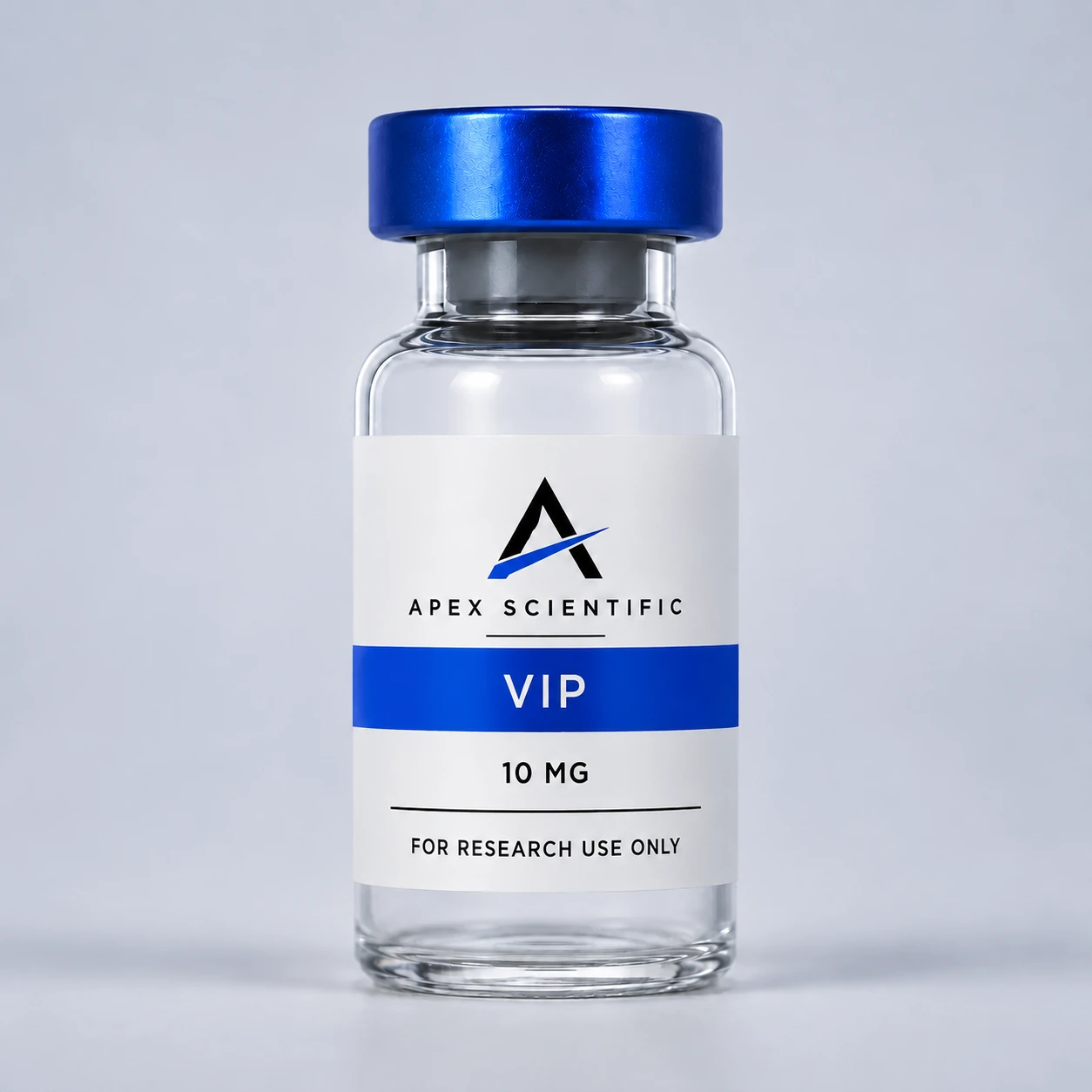
VIP, or vasoactive intestinal peptide, is an endogenous 28-amino-acid neuropeptide that signals mainly through the VPAC1 and VPAC2 receptors.
VPAC1 and VPAC2 are G-protein-coupled receptors that commonly activate adenylyl cyclase and cyclic-AMP signaling. Their distribution makes VIP useful for studying neural, vascular, intestinal, and immune signaling.
Cell, tissue, animal, and small human physiology studies describe VIP signaling, but they do not establish broad therapeutic benefits for a research material. Human infusion findings are exposure-specific and are not instructions for personal use.

Research model
These receptors, enzymes, and signaling networks define the primary laboratory questions associated with this research material.
VIP binding to VPAC1 commonly activates Gs proteins, adenylyl cyclase, and cyclic AMP. Structure–activity studies show that multiple residues across the 28-amino-acid peptide contribute to receptor binding and activation.
VPAC2 shares VIP sensitivity with VPAC1 but differs in tissue distribution and selected structure–activity relationships. Experiments use subtype-selective analogues to separate the two pathways.
Small infusion studies measured rapid clearance, vascular changes, parasympathetic activity, and headache-related endpoints after controlled VIP exposure.
Research interpretation
VIP binding to VPAC1 commonly activates Gs proteins, adenylyl cyclase, and cyclic AMP.
VPAC2 shares VIP sensitivity with VPAC1 but differs in tissue distribution and selected structure–activity relationships.
Small infusion studies measured rapid clearance, vascular changes, parasympathetic activity, and headache-related endpoints after controlled VIP exposure.
Cell, tissue, animal, and small human physiology studies describe VIP signaling, but they do not establish broad therapeutic benefits for a research material. Human infusion findings are exposure-specific and are not instructions for personal use.
Read the evidence
One important note
Human research consists of small, controlled physiology studies and does not establish a general therapeutic benefit for a research vial or support personal use.
This guide summarizes molecular mechanisms, published evidence, and evidence limits in everyday language. It is educational information, not medical advice or instructions for personal use. Products offered on this site are intended exclusively for laboratory research and are not for human or veterinary use.