Apex Scientific

21+ access.
Research use only.

Before entering, confirm that you meet the age requirement and understand the research-use limitations that apply to every Apex product.

Leave site

Your acknowledgement is remembered on this device for 30 days.

Research use only Clear product information Free shipping on orders over $200 20% launch offer · Use code APEX101

Compound guide

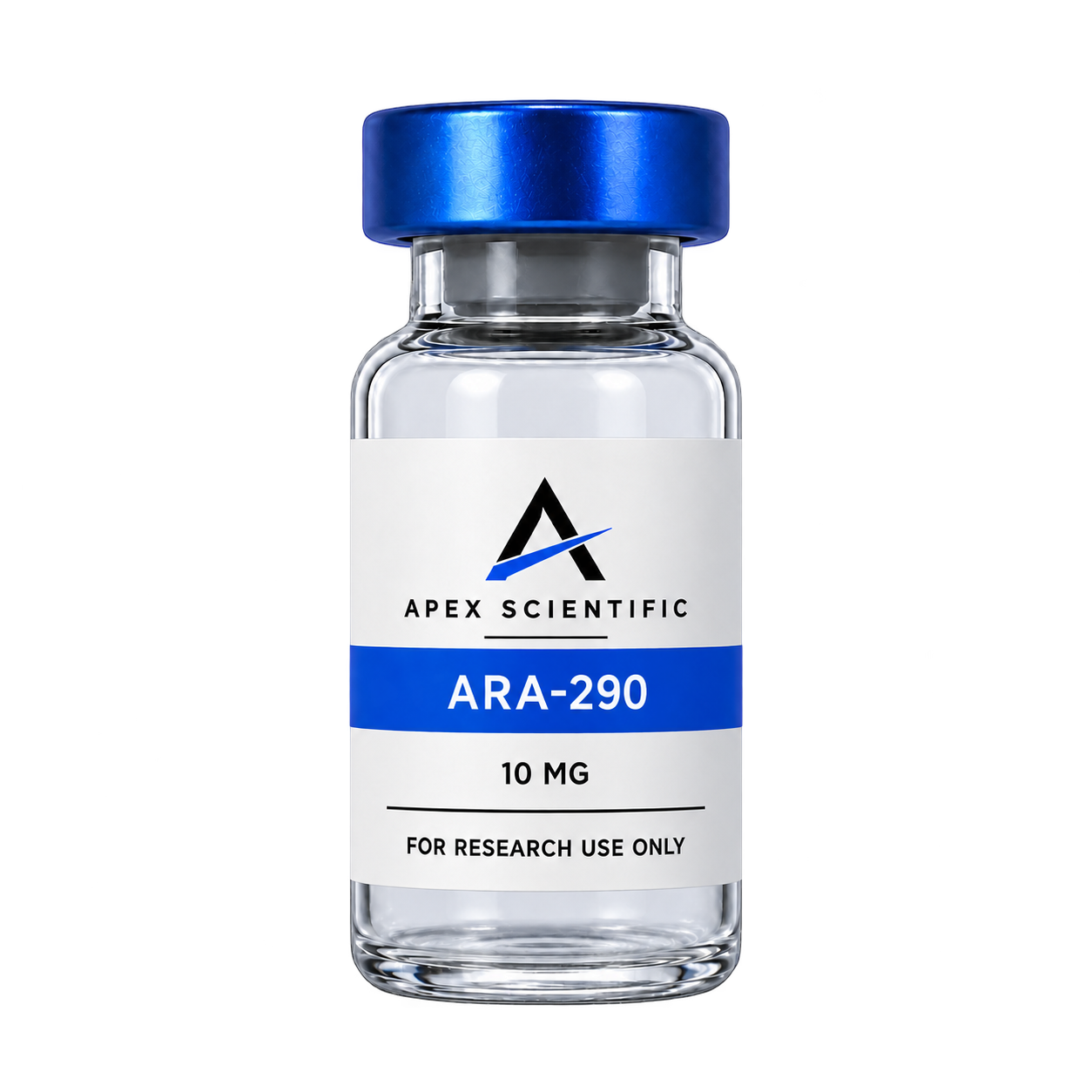
ARA-290

A pathway-focused guide to molecular mechanisms, published evidence, and the limits of interpretation.

Overview

A Summary:ARA-290

ARA-290, also called cibinetide, is an 11-amino-acid peptide modeled on part of erythropoietin. It is studied in cellular injury and small-nerve-fiber research.

A proposed innate repair receptor model involves EPOR and CD131. Reported downstream observations include inflammatory, oxidative-stress and cell-death markers; a broad therapeutic mechanism is not established here.

The 2012 randomized pilot enrolled 22 participants with sarcoidosis-associated symptoms. Other small studies measured nerve-fiber and metabolic endpoints. Their investigational formulations, selected populations and short observation periods limit interpretation; they do not validate this catalog vial.

Research model

Cellular & MolecularHow ARA-290 Is Studied

These receptors, enzymes, and signaling networks define the primary laboratory questions associated with this research material.

01Receptor-model hypothesis

Proposed EPOR / CD131 complex

At the cellular or molecular level

The literature describes an innate repair receptor distinct from the erythropoietin receptor system associated with red-cell production. EPOR/CD131 involvement is a proposed framework, not proof of every reported tissue effect.

02Stress, inflammation and apoptosis

Cellular injury response

At the cellular or molecular level

A cisplatin injury study in HEK-293 and ACHN cells measured reactive oxygen species, cytokines and apoptosis-related markers after exposure to ARA-290.

03Exploratory clinical measurements

Small-nerve-fiber endpoints

At the cellular or molecular level

Small studies in sarcoidosis or diabetes examined symptom questionnaires and corneal nerve-fiber measurements. Some endpoints changed, but the studies do not establish broad efficacy or long-term safety.

Map the research pathway

From target to research question

Follow each target through its intracellular signal, the model being observed, and the evidence boundary that governs interpretation.

01

Proposed EPOR / CD131 complex

Receptor-model hypothesis

The literature describes an innate repair receptor distinct from the erythropoietin receptor system associated with red-cell production.

Receptor-model hypothesis

Receptor-context experiments are needed to distinguish a pathway hypothesis from direct target engagement.

Interpret with limits

Pathway activity does not establish safety, efficacy, or suitability for personal use.

02

Cellular injury response

Stress, inflammation and apoptosis

A cisplatin injury study in HEK-293 and ACHN cells measured reactive oxygen species, cytokines and apoptosis-related markers after exposure to ARA-290.

Stress, inflammation and apoptosis

ROS, TNF-alpha/IL-6, caspase-3 and Bax/Bcl-2 readouts; these are model-specific markers, not patient outcomes.

Interpret with limits

Pathway activity does not establish safety, efficacy, or suitability for personal use.

03

Small-nerve-fiber endpoints

Exploratory clinical measurements

Small studies in sarcoidosis or diabetes examined symptom questionnaires and corneal nerve-fiber measurements.

Exploratory clinical measurements

Symptom scores, corneal nerve-fiber density and selected metabolic measures; interpret each study population and comparator separately.

Interpret with limits

Pathway activity does not establish safety, efficacy, or suitability for personal use.

Pathways examined together

Coordinated pathway model

  • Receptor-model hypothesis
  • Stress, inflammation and apoptosis
  • Exploratory clinical measurements

Research interpretation

How to read the pathway.

01

Receptor-model hypothesis

The research asks whether part of a hormone’s signaling can be separated from its other actions.

02

Stress, inflammation and apoptosis

These assays track how cells respond to a defined experimental stressor.

03

Exploratory clinical measurements

A change in a symptom score and a change in nerve imaging are different observations.

Evidence boundary

The 2012 randomized pilot enrolled 22 participants with sarcoidosis-associated symptoms. Other small studies measured nerve-fiber and metabolic endpoints. Their investigational formulations, selected populations and short observation periods limit interpretation; they do not validate this catalog vial.
Read the evidence

Sources BehindThis Guide

Ghassemi-Barghi et al. · Inflammation (2023; online 2022) · cellular injury model (opens in a new tab)Heij et al. · Molecular Medicine (2012) · 22-participant randomized pilot (opens in a new tab)Dahan et al. · Molecular Medicine (2013) · small-nerve-fiber study (opens in a new tab)Brines et al. · Molecular Medicine (2015) · exploratory diabetes/neuropathy trial (opens in a new tab)

One important note

Educational Notice

The 2012 randomized pilot enrolled 22 participants with sarcoidosis-associated symptoms. Other small studies measured nerve-fiber and metabolic endpoints. Their investigational formulations, selected populations and short observation periods limit interpretation; they do not validate this catalog vial.
This guide summarizes molecular mechanisms, published evidence, and evidence limits in everyday language. It is educational information, not medical advice or instructions for personal use. Products offered on this site are intended exclusively for laboratory research and are not for human or veterinary use.